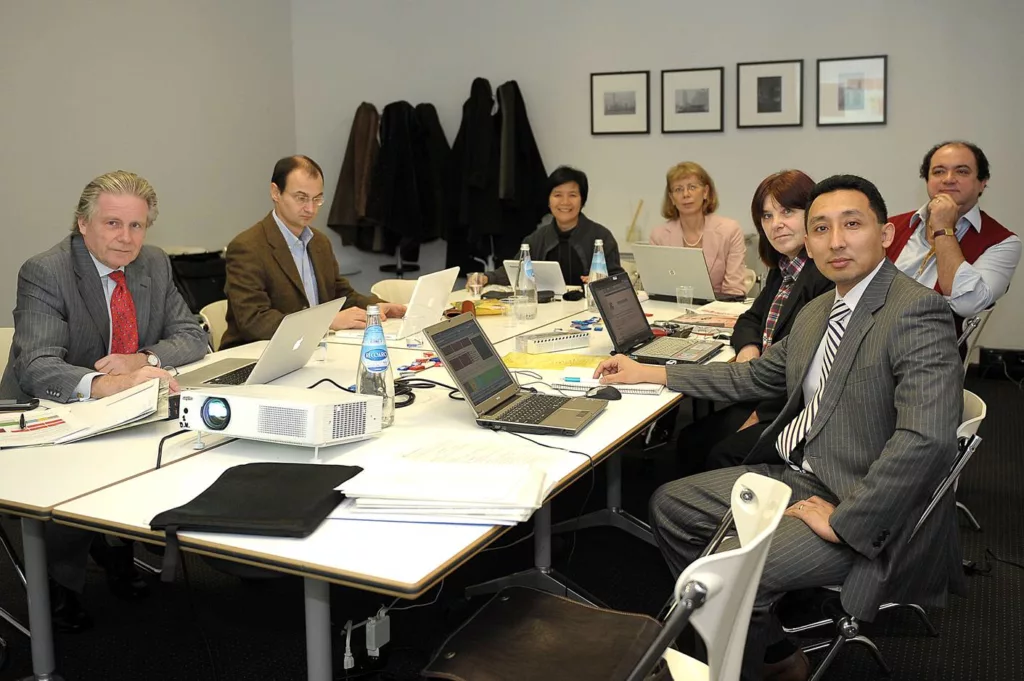
The following world-renowned gemmological laboratories (listed in alphabetical order) are represented within the LMHC:
- CISGEM Laboratory (Italy),
- GIA Laboratory (USA),
- GIT-Gem Testing Laboratory (Thailand),
- Gübelin Gem Lab Ltd. (Switzerland),
- Swiss Gemmological Institute - SSEF (Switzerland).
The LMHC meets several times a year to discuss and cooperate on various gemological issues and to harmonise the language used in their gemmological reports.
The Information Sheets (IS) issued by the LMHC, and linked below, help users to properly comprehend the language used in gemmological reports issued by LMHC members. So far nine Information Sheets (IS) have been issued by the LMHC:
|
|
|
- LMHC Information Sheet #2: "Corundum – lattice diffusion of foreign elements other than hydrogen":
(Version 5. January 2010) Members of the Laboratory Manual Harmonisation Committee (LMHC) have standardised the nomenclature that they use to describe any corundum that shows indications of heating accompanied by the introduction/diffusion of a chemical element from an external source, both for cases with clear supporting evidence and for those where indicators point to a possibility that this treatment has taken place but there is insufficient corroboration. See also Information Sheet #1.
|
|
|
- LMHC Information Sheet #3: "Corundum with glass filled fissures and/or cavities enhancing/modifying the clarity":
(Version 7. September 2010) Members of the Laboratory Manual Harmonisation Committee (LMHC) have standardised the nomenclature that they use to describe glass filled fissures and/or cavities in corundum and corundum-composite material. This nomenclature is used for all situations that (i) involve the filling of fissures and/or cavities with glass, where there are indications that the clarity of the corundum has been enhanced/modified by this process with the exception of those covered in Information Sheet #1 and (ii) form a corundum-glass composite material.
|
 |
- LMHC Information Sheet #4: "Padparadscha sapphire":
(Version 6. January 2010) Members of the Laboratory Manual Harmonisation Committee (LMHC) have standardised the nomenclature that they use to describe a 'padparadscha sapphire'. |
 |
- LMHC Information Sheet #5: "Emerald – fissure filling / clarity enhancement":
(Implemented January 2007, Version 2. September 2010) Members of the Laboratory Manual Harmonisation Committee (LMHC) have standardised the nomenclature that they use to describe an emerald.. |
 |
- LMHC Information Sheet #6: "Paraíba tourmaline":
(Version 4. September 2010) Members of the Laboratory Manual Harmonisation Committee (LMHC) have standardised the nomenclature that they use to describe a paraíba tourmaline. |
 |
- LMHC Information Sheet #7: "Corundum – No indications of heating and Indications of heating":
(Implemented January 2007, Version 2. January 2010) Members of the Laboratory Manual Harmonisation Committee (LMHC) have standardised the nomenclature that they use to describe any corundum that shows no indications of heating or any corundum that shows indications of heating. See also information sheets #1 to #4. |
 |
- LMHC Information Sheet #8: "Gemstones where colour authenticity is undertermined":
(Version 2 September 2010) Members of the Laboratory Manual Harmonisation Committee (LMHC) have standardised the wording they use to describe cases where colour authenticity is undetermined. These situations typically apply to beryl, demantoid garnet, quartz, spodumene (kunzite), topaz, tourmaline, zircon, zoisite (tanzanite), etc. |
 |
- LMHC Information Sheet #9: "Alexandrite and other colour-change gemstones":
(Version 2 September 2010) Members of the Laboratory Manual Harmonisation Committee (LMHC) have standardised the reporting nomenclature that they use to describe alexandrite and other colour-change gemstones. |
 |
- LMHC Information Sheet #10: "Amber and Copal":
(Version 3 December 2011) Members of the Laboratory Manual Harmonisation Committee (LMHC) have standardised the nomenclature that they use to describe amber and copal with indications of heating. This nomenclature is used for all resins that derive from natural fossilized resin (amber) and/or subfossilized resin (copal), showing indications of heating with or without pressure, with exception of dyed material.. |
 |
- LMHC Information Sheet #11: "Jade and related minerals":
(Version 4 September 2011) Members of the Laboratory Manual Harmonisation Committee (LMHC) have standardised the nomenclature that they use to describe nephrite jade, jadeite jade, omphacite, kosmochlor. |
|